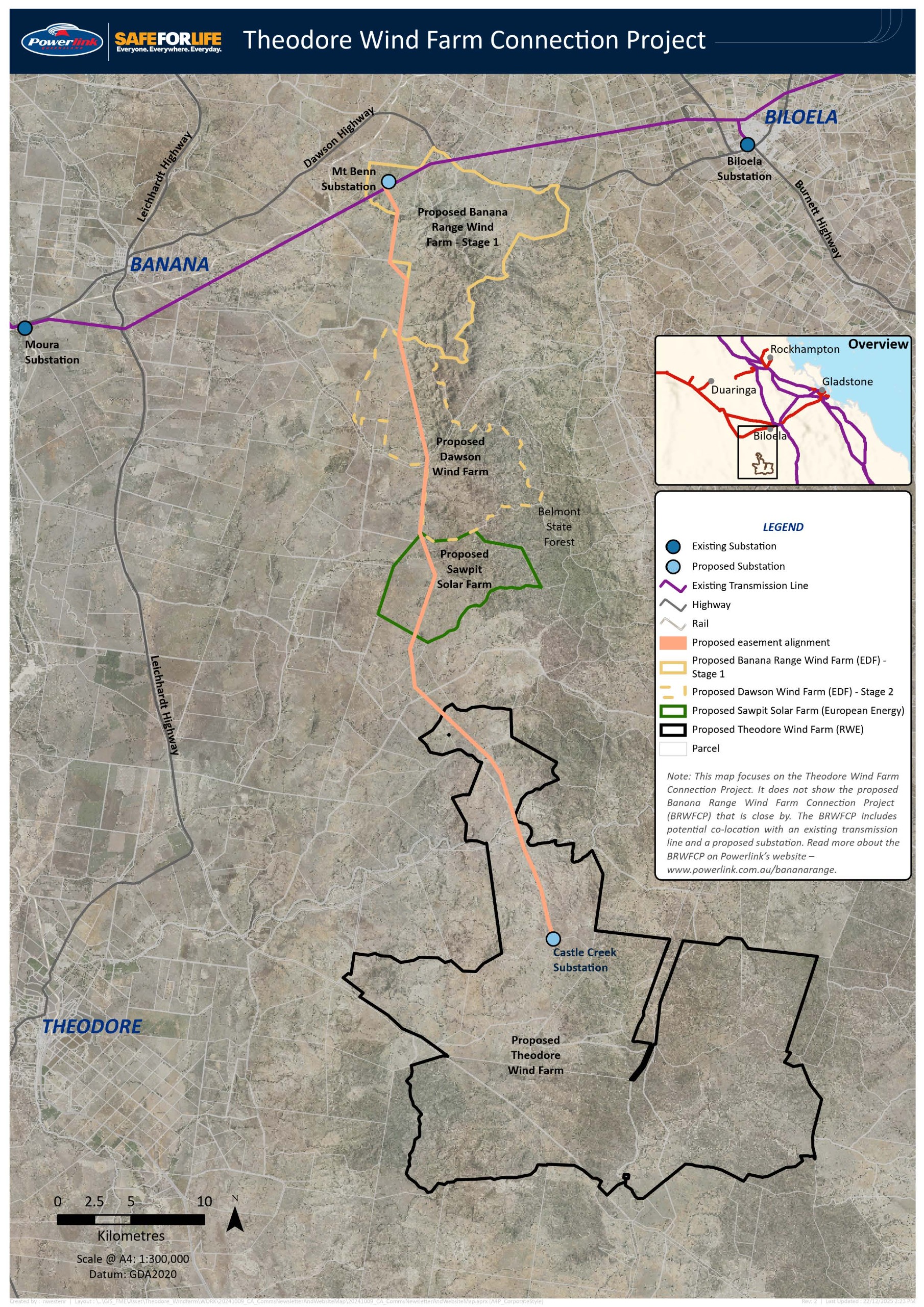
Powerlink is continuing to progress works to deliver a new 56km long transmission line to connect the Theodore Wind Farm to the transmission network.
The Theodore Wind Farm Connection Project involves:
- constructing a 56-km long, 275kV double circuit transmission line from the proposed Castle Creek Substation to the proposed Mt Benn Substation. The Mt Benn Substation is part of the Banana Range Wind Farm Connection Project and does not form part of the Theodore Wind Farm Connection Project.
- building new 275kV substation, to be known as the Castle Creek Substation and located within the Theodore Wind Farm.
The Theodore Wind Farm Project is a renewable energy development planned by RWE. Visit the RWE website for further information about the wind farm.
Environmental and Planning Approvals
Powerlink is progressing the project’s formal environmental and planning approvals process. The Theodore Wind Farm Connection Project requires both Federal and Queensland Government approvals which are being progressed concurrently.
Ministerial Infrastructure Designation process
Powerlink is seeking planning approval from the Queensland Government, under the Ministerial Infrastructure Designation (MID) process. This process is managed by the Department of State Development, Infrastructure and Planning (DSDIP) with input from other government agencies.
The Project’s MID Proposal Report was lodged with the DSDIP in December 2025.
On Friday 13 February 2026, DSDIP started the consultation period on the project’s MID Proposal Report (MID-1225-0981). This consultation was initiated and managed by DSDIP and was supported by Powerlink engagement activities, including letters, emails, signage and two community information drop-in sessions in Banana and Theodore.
Public consultation on the project’s MID Proposal Report ended at 5pm on Tuesday 24 March 2026.
The MID Proposal Report can be viewed online at DSDIP’s website and on this page under ‘Resources’ and MID Proposal.
Previous consultation
In October 2024, Powerlink released a Draft Corridor Selection Report (CSR) that identified a recommended corridor for the transmission line – building on RWE’s initial planning activities and assessments carried out.
Landholders, Traditional Owner groups, the community and other stakeholders were invited to provide feedback on the Draft CSR over a five-week consultation period.
Community information drop-in sessions were held in Biloela, Theodore and Banana in November 2024, where the community had the opportunity to meet our project team, ask questions and provide feedback.
Following consideration of feedback received and further technical analysis, we prepared the Final CSR in February 2025. Feedback received resulted in two changes being adopted to the 1km-wide recommended corridor.
You can view the Draft and Final CSRs on this webpage for more detail on our corridor selection process.
Following the release of the Final CSR, our Landholder Relations Team has continued to engage with directly affected landholders to progress environmental surveys and other on-site investigations, to enable the refinement of the final 1km-wide corridor to an easement alignment width of approximately 60m.
All previous reports and projects newsletters are available under the “Resources’ section of this page.
Federal environmental approval update
On 14 October 2025, Powerlink referred the project to the Department of Climate Change, Energy, the Environment and Water (DCCEEW) for assessment under the Environment Protection and Biodiversity Conservation Act 1999 (the EPBC Act). The EPBC Act is Australia’s national environmental legislation. It protects and manages Australia’s ‘nationally significant’ animals, plants, habitats and places.
A public comment period as part of the EPBC process closed on 5 November 2025. No submissions were received.
On 4 December 2025, DCCEEW determined that the project is not a ‘controlled action’ and therefore does not require any further assessment under the EPBC Act. The decision notice can be viewed online at epbcpublicportal.environment.gov.au/all-referrals/.
Project map
Frequently asked questions
Powerlink’s Theodore Wind Farm Connection Project is subject to separate planning and environmental approvals from RWE’s wind farm development.
Powerlink is progressing the planning approval for this project through the Ministerial Infrastructure Designation (MID) process, which is managed by the Department of State Development, Infrastructure and Planning (DSDIP). On 21 November 2025, DSDIP provided endorsement for Powerlink to submit the MID Proposal Report. The MID Proposal Report was lodged with DSDIP in December 2025. Public consultation period on the report (MID-1225-0981) ends at 5pm on Tuesday 24 March 2026.
Additionally, Powerlink is seeking environmental approval for the project from the Federal Government. On 14 October 2025, Powerlink referred the project to the Department of Climate Change, Energy, the Environment and Water (DCCEEW) under the Environment Protection and Biodiversity Conservation Act 1999 (EPBC Act). The public consultation period led by DCCEEW was open from 22 October 2025 to 5 November 2025. No submissions were received.
On 4 December 2025, DCCEEW determined that the project is not a ‘controlled action’ and therefore does not require any further assessment under the EPBC Act. The decision notice can be viewed online at epbcpublicportal.environment.gov.au/all-referrals/.
Subject to approvals being obtained, construction is expected to commence in Q4 2026 and be completed in late 2028
Theodore Wind Farm received State Development Approval in June 2025 and is continuing to work through Federal Government environmental approval (under the EPBC Act) and community consultation. The Theodore Wind Farm’s Battery Energy Storage System (BESS) will have a planned capacity of 240 megawatts. It will be located near to the substation in the northern area of the wind farm site.
Timelines and further information on Theodore Wind Farm activities and community benefits are available at theodorewindfarm.com.au or by emailing theodorewindfarm@rwe.com.
About Castle Creek Substation
As part of the Theodore Wind Farm Connection Project, Powerlink is also seeking the necessary approvals for the planning, design and construction of a substation within the wind farm boundary, referred to as Castle Creek Substation.
The name ‘Castle Creek’ was selected to recognise the Theodore township was originally known as Castle Creek.
Selection of the Castle Creek Substation site was confirmed with key input provided from RWE to ensure the substation was appropriately integrated with RWE’s wind farm infrastructure. The same criteria used for corridor selection - social, environmental and economic values - were applied when selecting the new substation location.
Project design features
It is likely the new 275kV transmission towers will be up to 60m high, depending on specific-site conditions. This can include consideration of terrain, topography and land use within the final easement alignment, with shorter towers likely on higher ground and taller towers within lower points of the corridor.
Concrete tower pads (which the towers stand on) will typically be 40m x 40m. The distance, or span, between towers will likely be up to around 450m.
Wherever possible, Powerlink does not clear the entire easement but rather minimises vegetation removal to the amount required to ensure the safe and reliable operation of and access to the transmission line.
When designing the line, mitigation measures such as selective tower placement and spanning to decrease the amount of required vegetation clearing will be used, particularly in sensitive environments.
Biosecurity
We know that effective prevention and management of identified weeds, pests and pathogens is a high priority for landholders. We comply with the Biosecurity Act 2014 around ‘restricted and prohibited matter’ and take all reasonable and practical actions to ensure our activities do not introduce or spread biosecurity matter, as per our general biosecurity obligation.
Our Land Access Protocol sets out an agreed approach for how and when we access a landholder's property. Understanding land use, property management and biosecurity plans is key to this process. More information can be found in our ‘Managing biosecurity on your property’ brochure at powerlink.com.au/brochures/managing-biosecurity-your-property.
Powerlink will work with landholders to identify biosecurity risks on each property. We discuss biosecurity and weed management with landholders during our initial meetings. This helps us understand any biosecurity risks and develop appropriate management measures to avoid spreading weeds, diseases and pathogens.
We value our long-term, working relationships with landholders, and maintain communication about biosecurity from a project’s planning phase through to construction, operation and maintenance.
Transmission projects have multiple levels of governance for managing biosecurity risks. A Biosecurity Management Plan is developed early and is part of an Environmental Management Plan (EMP). The EMP outlines Powerlink's key controls (e.g. biosecurity protocols and vegetation management strategies) to minimise the spread of biosecurity material as part of our activities.
The EMP forms part of the MID Proposal Report (see Chapter 25). Once approved, the EMP feeds into the Health, Safety and Environment Specification for contractors, to ensure on‐site workers are aware of obligations and commitments.
For ongoing easement access and maintenance, biosecurity requirements are documented in an Environmental Works Plan (EWP). The EWP is the main tool for identifying biosecurity risks at Powerlink sites on a property. It is developed in consultation with each landholder and displays all known biosecurity considerations for a location, and any access requirements or constraints.
Powerlink employees and contractors are made aware of biosecurity risks and are provided maps and training to ensure they understand procedures and obligations for site visits.
Powerlink conducts regular wash downs to reduce the risk of spreading weeds, as well as soil-borne pests and diseases, and has dedicated wash down facilities across our transmission network. Our people and contractors are trained to know when and how to conduct vehicle wash downs and comply with the following:
- complete the national standard training, ‘Inspect and clean machinery of plant, animal and soil material’ (AHCBIO201A), on projects or locations where there is a high biosecurity risk
- comply with Queensland Government inspection and wash down procedures
- only carry out wash downs at designated locations
- complete a Biosecurity Declaration Form after completing a wash down and before accessing the next property or biosecurity zone.
Projects in Central Queensland
Learn more about Powerlink's other projects in Central Queensland