Background
Powerlink is proposing to build a new high voltage transmission line between the existing Bouldercombe and Larcom Creek substations.
The project will reinforce electricity supply to the Gladstone region and increase network capacity and reliability to service the evolving industry in this area.
Gladstone West Substation
Powerlink acquired land for a new substation and is in the early stages of planning.
For planning and environmental approval purposes, this substation is part of the Bouldercombe to Larcom Creek Transmission Line Reinforcement Project.
The Gladstone Project
The Gladstone Project forms part of Powerlink’s broader program of work to reinforce the transmission network in Central Queensland. More information can be found at powerlink.com.au/projects/gladstone-project.
Project map
For more details on each of the sections marked in the below map, please read our project newsletters (available in the ‘Resources’ section.
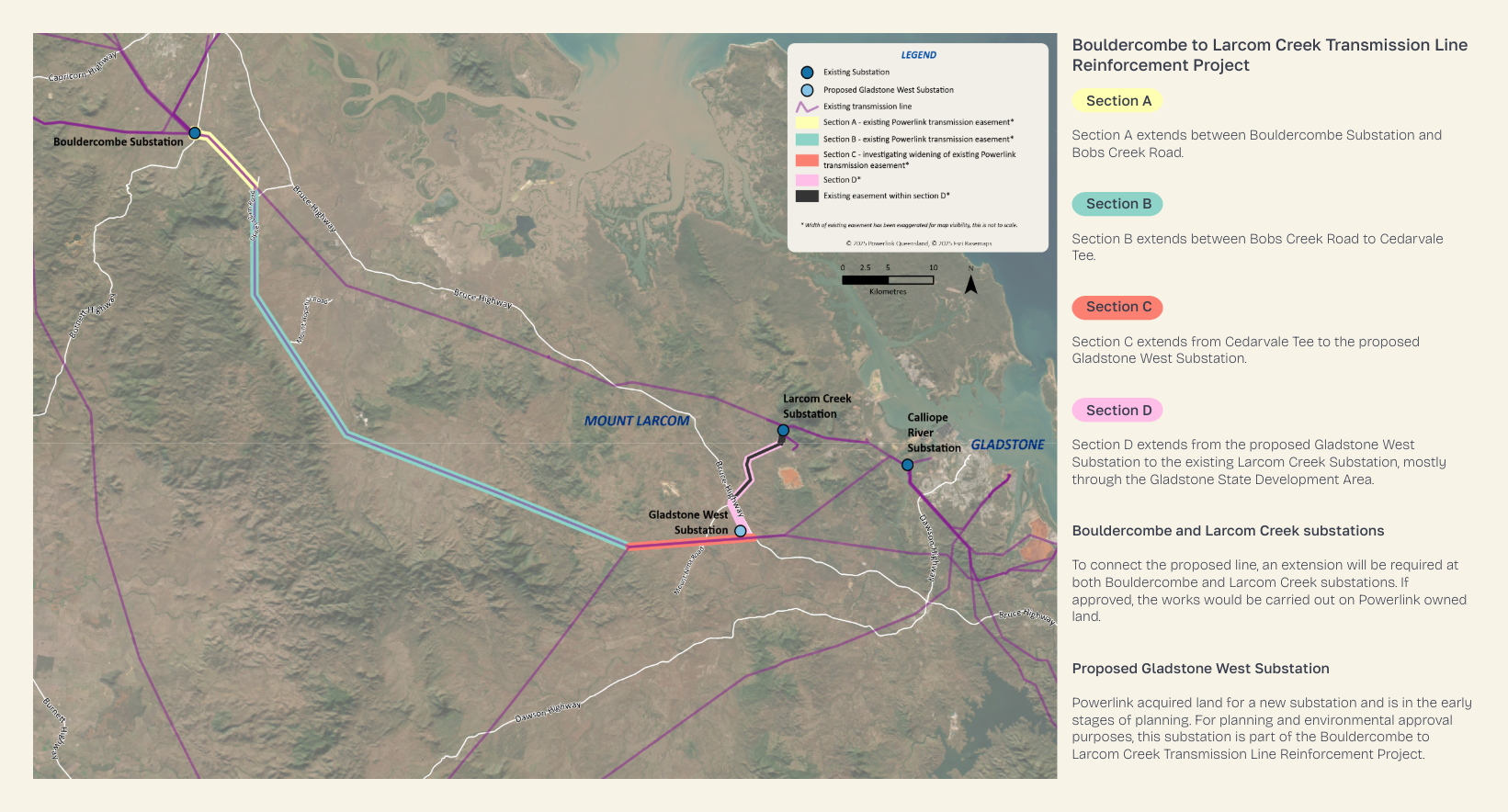
Click to enlarge
Frequently Asked Questions
We have answers to some of the most frequently asked questions from the local community about the Bouldercombe to Larcom Creek Transmission Line Reinforcement project. If you have a question that hasn't been answered here, please reach out to the project engagement team.
About the project
The proposed project involves building a 275kV double-circuit transmission line, about 95km in length. This line will improve network capacity and reliability as coal-fired generation reduces and industrial electrification increases. Connecting the new line to our transmission network will also involve a minor extension to existing substation footprint to accommodate the proposed line at both the Bouldercombe and Larcom Creek substations.
A new substation at Gladstone West is also proposed to be constructed on Powerlink-owned land. The new substation will help reinforce the network ahead of the eventual closure of the Gladstone Power Station. The proposed Gladstone West Substation will form part of the planning and environmental approvals required for the Bouldercombe to Larcom Creek Transmission Line Reinforcement project.
The project is being progressed to maintain system security and reliability of electricity supply to the Central Queensland region. The project responds to a material increase in electricity transfer needs into the Gladstone area. This is driven by the anticipated closure of Gladstone Power Station and the need to support the decarbonisation of major industries as the energy system transitions.
The project is divided into four sections, A-D. In Sections A and B, the proposed 275kV transmission line will be constructed within existing Powerlink easements and co-located alongside existing transmission lines. Section C requires easement widening to support the proposed line and co-located alongside existing transmission lines. Section D involves using a mix of existing vacant easements and the acquisition of new easements.
In October 2025, Powerlink released two corridor reports for this project. The first was a corridor validation report (for Project sections A, B and C); the second a draft corridor selection report (for Project Section D).
Landholders, Traditional Owner groups, the community and other stakeholders were invited to provide feedback on the reports over a four-week consultation period.
Powerlink has now reviewed all feedback and is continuing with technical studies to inform the next steps of the project including the final corridor selection report for Section D.
EMFs are fields produced wherever electricity is generated, transmitted or used. EMF are found everywhere electricity or electrical equipment is used, including in the home, office, work sites and around transmission lines. More information is available in our EMF Information Sheet, which includes visual comparisons showing how EMF levels from transmission lines and substations compare to common household appliances.
For this project, Powerlink has engaged an independent specialist to undertake an EMF assessment on the existing transmission lines and model what the new proposed line will emit. We will discuss and share the findings with the community once this work is complete.
During operation, transmission lines can generate low levels of noise. This is most commonly caused by wind or a natural electrical effect called corona discharge, which can occur during wet weather conditions.
During operation, transmission lines can generate low levels of noise. Wind or a natural electrical effect called corona discharge, which can occur during wet weather conditions, are the most common causes of this low-level noise.
Following feedback received, Powerlink is seeking to understand the existing background noise in the project area and how this might change because of the project. The change in noise will consider both potential operational and maintenance noise.
Our focus will be on the potential change for properties close to the existing line in Section A. This work will be undertaken when the project’s design has progressed further (likely in mid-late 2026). We will share the results of this work when they become available.
Depending on the outcome of this work, we will identify what may be required to be addressed as part of our planning approvals.
The Queensland Government’s Environmental Protection (Noise) Policy 2019 sets out the environmental values for acoustic environment and acoustic quality objectives that will meet these values. Powerlink will use the Environmental Protection (Noise) Policy to guide our work in this area.
Biosecurity and environmental approvals
We understand biosecurity is a priority for landholders. We take biosecurity seriously and have processes in place to avoid spreading weeds between properties or introducing new weeds from outside the local area. For example, we take preventative measures to minimise exposure to weeds, such as:
- conducting regular vehicle wash downs
- avoiding travel through areas heavily affected by biosecurity matter
- visiting clean areas first, before travelling to affected areas
- staying on roads and designated access tracks in work areas
- obtaining weed and seed declarations on any fill material brought onto a property.
Powerlink will work with landholders to identify biosecurity risks on each property and develop appropriate management measures, including those referred to in existing biosecurity management plans. We value our long-term, working relationships with landholders, and intend to work with landholders regarding biosecurity from the planning phase through to construction, operation and maintenance. For more information on Powerlink’s approach to biosecurity, please visit our project web page and access the Biosecurity Frequently Asked Questions from the Resources menu.
Powerlink is working with the relevant Federal and State government departments regarding the appropriate planning and environmental approvals pathway for this project. We will continue engaging with landholders, Traditional Owner groups, the wider community and other stakeholders as planning progresses.
Powerlink will also comply with the engagement requirements of formal planning and approval processes undertaken, which may include supporting formal submission periods undertaken by government. When the approvals pathway is confirmed, stakeholders will be advised of the associated opportunities to provide feedback.
State Planning Approvals
Powerlink’s transmission projects are typically assessed through a Ministerial Infrastructure Designation (MID). However, sections C and D of this project are likely to require additional approvals, as they intersect with the Gladstone State Development Area (GSDA) and the Callide Infrastructure Corridor State Development Area.
Federal Environmental Approvals
Based on the outcomes of our initial ecological surveys, the project is considered likely to have a significant impact on Matters of National Environmental Significance (MNES). Powerlink is working with the Department of Climate Change, Energy, the Environment and Water (DCCEEW) and will refer the project for assessment under the Environment Protection and Biodiversity Conservation Act 1999 (EPBC Act).
Powerlink’s role in developer-led projects
Powerlink is a Government Owned Corporation that owns, develops, operates and maintains the high voltage electricity transmission network in Queensland. Our network extends 1,700 kilometres from Cairns to the New South Wales border. Our purpose is to connect Queenslanders to a world-class energy future.
In addition to developing and operating the high voltage network and associated infrastructure, Powerlink also provides electricity transmission services. This can include connecting large industry and electricity generation projects (such as wind farms, solar farms, gas, battery storage and others) to the transmission network.
While developers of electricity generation projects regularly approach Powerlink requesting connection of their proposed facility to the transmission network, it is not Powerlink’s role to approve developer-led projects.
Under the National Electricity Rules, Powerlink must make an offer to connect to our network if the developer satisfies certain criteria.
Powerlink is bound by confidentiality obligations throughout the whole process of connection from inception to operation and decommissioning (including specific obligations under the National Electricity Rules).
This means that Powerlink is restricted in what information we can share about potential connections to our transmission network.
We may only be able to share publicly available information such as information published on the Australian Energy Market Operator (AEMO) website.
Developers may be actively speaking with landholders and community members about their proposed project in very early phases of project development, even well in advance of them making contact with Powerlink.
For more information on how developer-led projects connect to the transmission network, visit our Connections and Confidentiality factsheet.
For further information on proposed developments, please refer to our Central Queensland regional updates (available on the right side of this website, under ‘Resources’). This publication features a detailed map of Powerlink’s Queensland Transmission Network in Central Queensland. It also presents existing renewable energy projects (non-Powerlink) that are in operation, and prospective renewable energy projects (non-Powerlink) currently going through planning and approval stages.
Visual amenity and placement of new transmission
Powerlink understand that visual impact is a concern for the community. Based on the feedback received so far, we are engaging an independent consultant to consider design options near Bouldercombe Substation, which may help lessen these impacts. Any potential changes remain constrained by project requirements, including technical and economic feasibility.
As we progress through our State Government planning approvals, we may also be required to undertake a visual impact assessment.
It is important to note that opportunities to screen views of transmission towers are limited. As there is already existing transmission infrastructure in the landscape, any new towers are expected to result in an incremental increase to the current visual impacts.
During the preparation of the corridor validation report, Powerlink reviewed the existing transmission easement between the Bouldercombe and Larcom Creek substations.
The outcome of this report identified the southern side of the easement as the preferred location for the proposed new line because it enables a straighter and more efficient route, avoids crossing existing lines, and is better placed for connection into the Bouldercombe Substation.
In response to feedback received from the community, our project team is continuing to explore design options to understand if potential impacts can be reduced.
All options must be assessed against project requirements, including technical feasibility, environmental considerations, timeframes and cost. When this work is complete, Powerlink will share the findings with the community.
For further information comparing high voltage overhead and underground transmission infrastructure, visit Comparing overhead and underground transmission infrastructure.
Other Central Queensland projects
Explore our projects shaping Central Queensland's energy future